
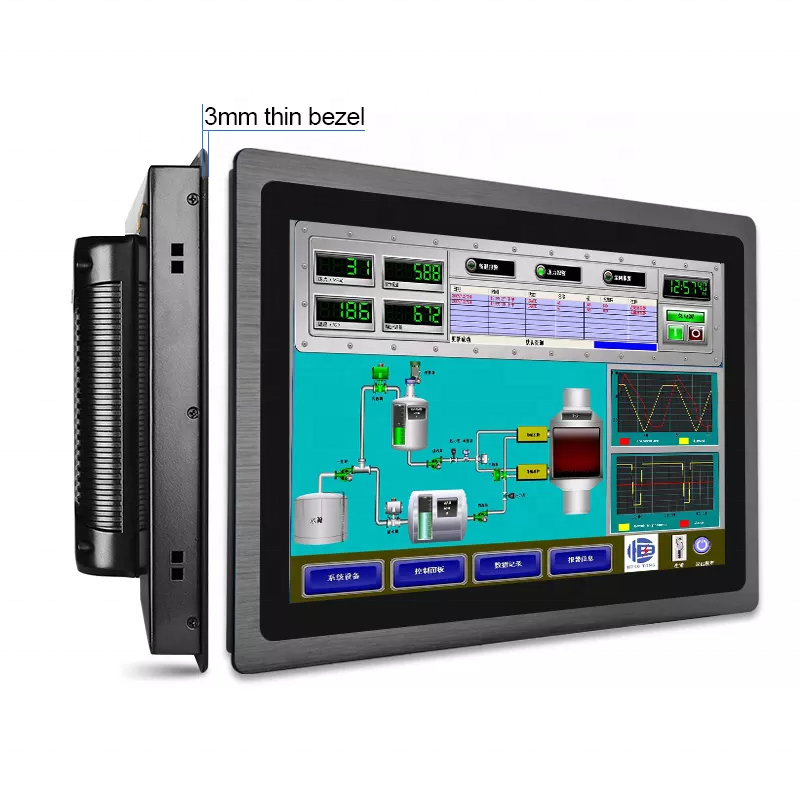
Sunlight-Readable Brightness: Engineering 1000+ Nits for Industrial Touchscreen Monitors
Why 1000+ nits is critical for outdoor and high-ambient-light industrial touchscreen monitor deployments
Most regular commercial displays run around 250 to 400 nits, which is way too dim when there's more than 10 thousand lux of ambient light around. The industrial grade touchscreen monitors that hit over 1000 nits stay readable even in bright sunlight conditions. Think about places like construction zones, busy transport centers, or those control panels deployed out in the field. When screens are this bright, they basically beat back the sun glare, making sure workers can actually see what matters for safety reasons and keeping data accurate. Some studies indicate that anything below 700 nits drops readability by about 40 percent in full sun exposure. That kind of visibility loss becomes a real problem in work settings where reading wrong numbers could lead to dangerous mistakes down the line.
LED backlighting, optical bonding, and anti-reflective coatings: integrated solutions for glare reduction and readability
Sunlight readability isn't achieved by brightness alone—it requires coordinated optical engineering:
- High-efficiency LED backlighting sustains stable 1000+ nit output with optimized power draw
- Optical bonding eliminates air gaps between the display panel and cover glass, cutting internal reflection by up to 90%
- Nanoscale anti-reflective coatings minimize external light scatter before it reaches the viewing surface
| Feature | Standard Display | Industrial Solution | Performance Gain |
|---|---|---|---|
| Reflection Reduction | 8–12% surface reflectivity | <2% reflectivity | 6× improvement |
| Contrast Retention | 15:1 in sunlight | 50:1 in sunlight | 233% increase |
| Viewing Clarity | Washed out at >30k lux | Legible at >100k lux | Critical for HMI use |
This layered approach preserves touch accuracy, color fidelity, and response consistency—enabling reliable 24/7 operation in refineries, agricultural equipment, and other high-glare industrial settings.
Wide Viewing Angle Performance in Industrial Touchscreen Monitors
Industrial touchscreen monitors serve dynamic workspaces where operators interact from multiple positions—standing, seated, or moving around machinery. Consistent visual clarity across angles prevents misinterpretation of alarms, diagnostics, or process metrics, especially during time-sensitive decisions.
IPS Panel Advantages: Consistent Color, Contrast, and Touch Responsiveness Across 178° Viewing Angles
IPS panels have become pretty much the norm when it comes to displays that need good viewing angles. While TN panels tend to mess with colors and contrast once someone looks at them from more than about 30 degrees away, IPS screens keep their quality intact almost all the way around, going up to nearly 180 degrees both ways. This means no more annoying color shifts that might make important things like red warning signals or pressure readings hard to see. The benefit doesn't stop there either. Touch response stays solid even when users are looking at the screen from odd angles or have thick gloves on during winter months, which makes these displays particularly useful in industrial settings where conditions aren't always ideal.
Real-world applications demand this consistency:
- Medical teams reviewing imaging data from varied positions around a single monitor
- Warehouse supervisors verifying inventory from forklift cabs or elevated platforms
- Control room staff interpreting real-time, color-coded system status without distortion
IPS achieves this through liquid crystal alignment parallel to the substrate, minimizing light leakage. When paired with industrial-grade lamination, it sustains contrast ratios exceeding 1000:1—even under strong overhead lighting.
Rugged Reliability: Environmental Protection and Touch Input Integrity for Industrial Touchscreen Monitors
IP65 front-sealed design, thermal-hardened glass, and EMI-shielded controllers for 24/7 operation in harsh settings
Industrial environments impose stresses that rapidly degrade consumer-grade displays: dust, moisture, thermal cycling, and electromagnetic noise. Purpose-built monitors integrate three core protections:
- IP65 front-sealing blocks dust ingress and resists water jets from any angle—addressing particulate contamination, a leading cause of failure in food processing and mining (Reliability Engineering Journal, 2023)
- Thermal-hardened, chemically strengthened glass retains optical clarity and touch sensitivity across -30°C to 70°C, preventing delamination and calibration drift common in unhardened panels
- EMI-shielded controllers guard against interference from welding arcs, motors, and RF sources—mitigating signal disruption that affects 1 in 3 unprotected control systems annually
| Protection Feature | Failure Risk Reduction | Operational Benefit |
|---|---|---|
| IP65 Sealing | 89% fewer dust/water failures | Continuous use in washdown environments |
| Thermal-Hardened Glass | 70% less touchscreen calibration drift | Reliable input in foundries/freezers |
| EMI Shielding | 92% signal integrity improvement | Stable operation near industrial motors |
Together, these features support uninterrupted 24/7 operation in oil rig control rooms, automotive assembly lines, and other mission-critical settings—where monitor downtime costs exceed $15,000/hour. In accelerated stress testing, these monitors achieve ¥200,000-hour lifespans—400% longer than consumer-grade alternatives.
Balancing Performance and Efficiency: Thermal Management and Power Optimization in Industrial Touchscreen Monitors
Sustaining 1000+ nits and wide-angle clarity demands robust thermal and power management—without compromising reliability or longevity. High-brightness operation generates significant heat; unchecked, it accelerates component aging and degrades touch accuracy.
Effective industrial designs combine passive thermal dissipation, adaptive power regulation, and intelligent backlight control:
- Copper heat sinks and thermally conductive materials efficiently channel heat away from LEDs and controllers
- Dynamic voltage scaling reduces power to processing units during idle periods—cutting consumption by up to 40% without affecting wake responsiveness
- Temperature-regulated LED backlighting modulates brightness based on ambient conditions, lowering thermal load in cooler environments while preserving visibility in heat
This integrated strategy minimizes heat generation in enclosed cabinets, extends component life, and supports energy-efficient operations—all while maintaining full 1000+ nit output when required. The result is a sustainable balance: uncompromised visual performance, continuous uptime, and lower total cost of ownership.
FAQ
What are industrial touchscreen monitors?
Industrial touchscreen monitors are robust displays designed for demanding environments like construction sites, control rooms, and refineries, offering high visibility and durability.
Why is sunlight readability important for touchscreen monitors?
Sunlight readability ensures that the screen remains visible in bright outdoor conditions, which is crucial for environments with high ambient light levels to avoid errors and ensure safety.
How do industrial monitors achieve over 1000 nits of brightness?
They use high-efficiency LED backlighting, optical bonding, and anti-reflective coatings to achieve such brightness levels and reduce glare.
What is the significance of IPS panels in industrial monitors?
IPS panels provide consistent color and contrast across wide viewing angles, ensuring clarity and touch responsiveness from various positions.
How do industrial monitors manage thermal performance?
They utilize passive thermal dissipation, adaptive power regulation, and intelligent backlight control to manage heat and maintain performance.
Table of Contents
- Sunlight-Readable Brightness: Engineering 1000+ Nits for Industrial Touchscreen Monitors
- Wide Viewing Angle Performance in Industrial Touchscreen Monitors
- Rugged Reliability: Environmental Protection and Touch Input Integrity for Industrial Touchscreen Monitors
- Balancing Performance and Efficiency: Thermal Management and Power Optimization in Industrial Touchscreen Monitors
- FAQ